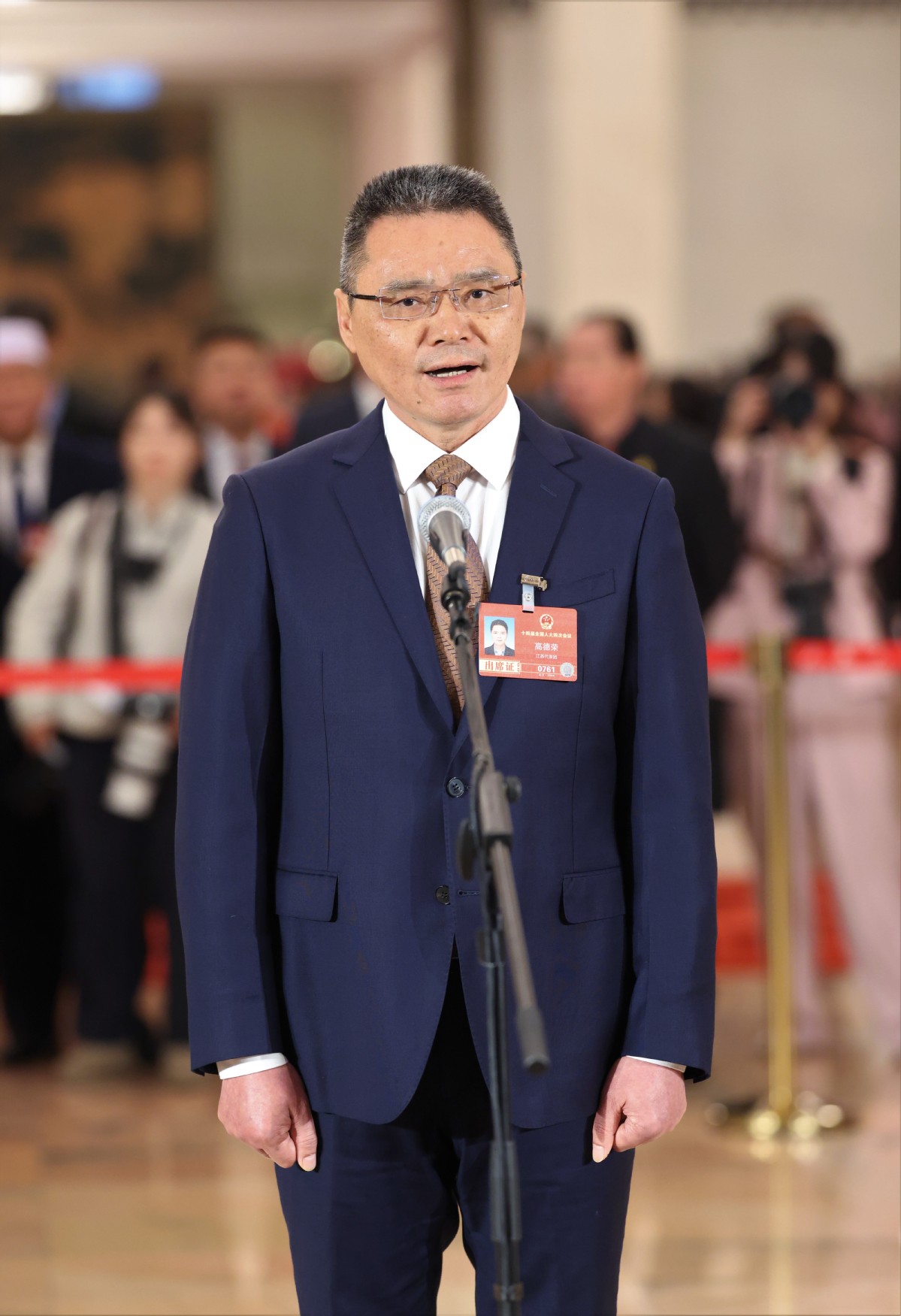
Gao Derong, a deputy to the 14th National People's Congress, attends a group interview ahead of the opening meeting of the fourth session of the 14th NPC at the Great Hall of the People in Beijing, March 5, 2026. [Photo by Wang Jing/chinadaily.com.cn]
For more than 30 years, agricultural researcher Gao Derong has adhered to the farming calendar while working on wheat breeding. As a deputy to the National People's Congress, Gao employs molecular breeding techniques to protect wheat fields from devastating diseases and bolster China's food security.
During an interview at the ongoing two sessions on Thursday — which coincided with Jingzhe, or the Awakening of Insects solar term — Gao discussed his efforts to cultivate high-yield, disease-resistant wheat varieties.
Based at the Lixiahe Agricultural Research Institute in Jiangsu province, Gao has concentrated much of his work on combating fusarium head blight, often referred to as the "cancer of wheat". This disease thrives in the high humidity and heavy rainfall of the lower Yangtze River region, with severe outbreaks capable of destroying entire harvests.
To overcome the limitations of traditional breeding methods, Gao's team turned to molecular technology, inserting disease-resistance genes directly into seeds. "After 30 years of testing countless combinations, we successfully cultivated our first highly scab-resistant wheat variety in 2021," Gao said.
This new variety enables farmers to reduce pesticide use while maintaining stable harvests, producing up to 9 metric tons per hectare (about 600 kilograms per mu) in demonstration fields.
"We have also been improving wheat varieties to ensure people not only have enough to eat, but eat well," he said.
In southern China, tight crop rotation schedules between rice and wheat often force farmers to delay winter wheat planting. In response, Gao's team developed Yangmai 25, a fast-growing variety that can yield up to 9 tons per hectare even when planted as late as December.
The team has also developed high-quality, weak-gluten wheat tailored for biscuits and pastries, helping reduce China's reliance on imported flour.
Additionally, Gao noted that his previous suggestion to increase national investment in high-standard farmland construction was adopted, raising funding from 26,250 yuan to 45,000 yuan ($3,806 to $6,524) per hectare.
"I will continue to deeply cultivate the wheat fields, allowing the land to produce more grain and farmers to earn more income," Gao said.


